
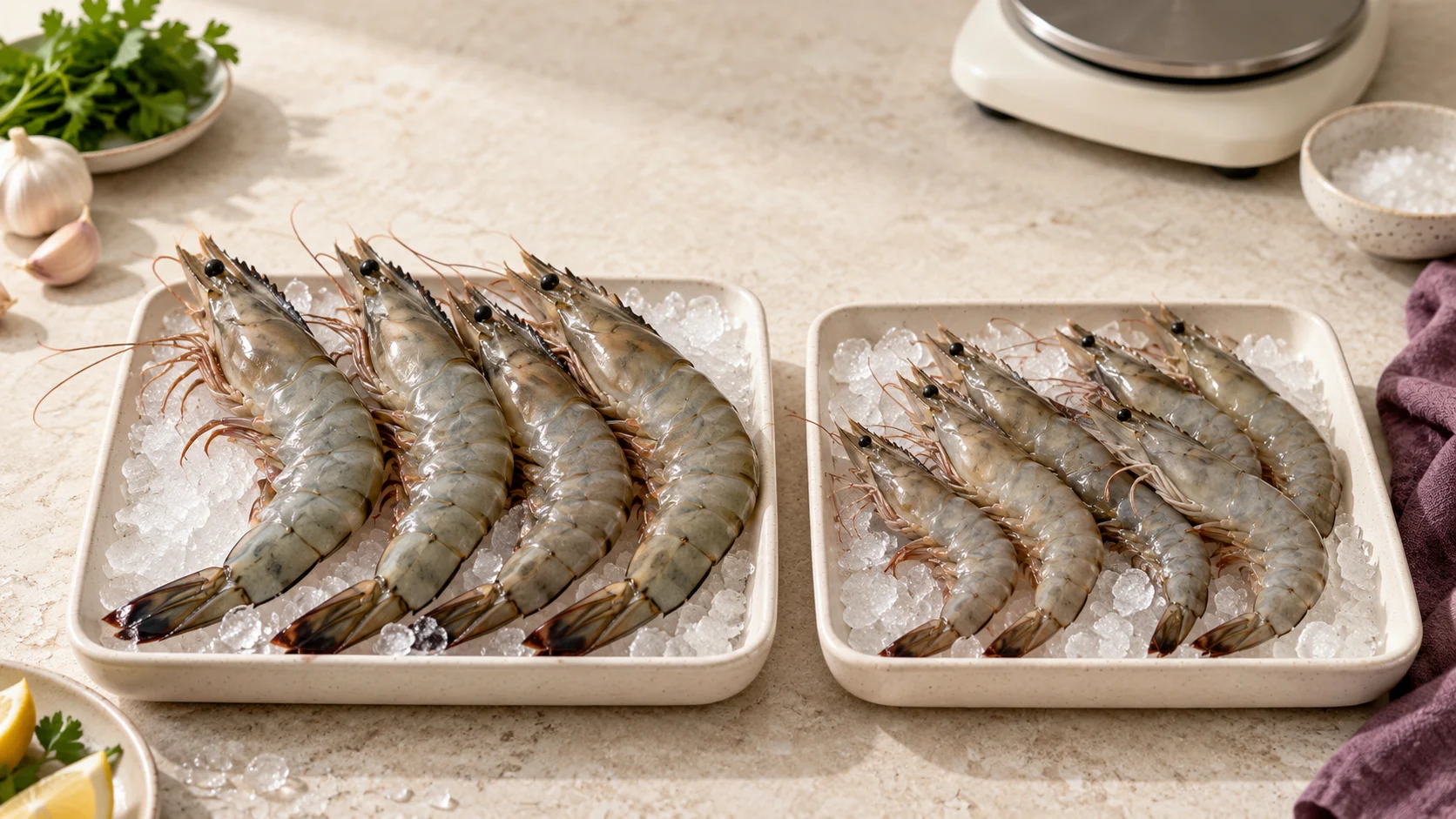
Cover: AI-generated food illustration; no specific seller product is depicted.
31/40 means a size grade of 31–40 prawns per stated unit of weight. Check whether the label says per pound or per kilogram. With the same unit and preparation, a lower count means larger individual prawns.
That missing unit changes the purchase. A 31/40-per-kilogram prawn is larger on average than a 31/40-per-pound prawn: the same number makes up 1kg rather than about 454g. A pack weighing 1kg can still use a per-pound size grade, so the bag's weight alone does not tell you the count unit.
Read the count before “large” or “jumbo”
Look for wording such as “31–40 pcs/lb” or “31–40 pcs/kg”. If a listing gives only “31/40”, ask the seller which unit it uses before estimating the number of prawns you will receive.
Count-per-pound sizing is a common convention described by the Florida Department of Agriculture's shrimp guide. It is not a reason to assume every Singapore listing uses pounds. The international Standard for Quick-Frozen Shrimps or Prawns permits packing by count per unit weight or per package.
Here is how common count ranges compare when every row uses the same unit and preparation:
| Count label | Meaning per stated unit | Relative size within this table |
|---|---|---|
| 16/20 | 16–20 prawns | Largest |
| 21/25 | 21–25 prawns | Larger than 26/30 |
| 26/30 | 26–30 prawns | Between 21/25 and 31/40 |
| 31/40 | 31–40 prawns | Smaller than 26/30 |
| 41/50 | 41–50 prawns | Smallest |
These are count ranges, not a guarantee that your bag contains the top number. Nor does “31/40” by itself mean 31–40 in the whole bag.
Choose the size around how you want to serve it
For a whole-prawn dish, grilling or a platter where you want a few substantial pieces, start by comparing lower-count packs. Check that the pack has the shell and head preparation your recipe expects.
For fried rice, noodles or an omelette, a higher-count peeled pack gives you more individual pieces for the same weight. If you intend to chop the prawns anyway, paying extra specifically for larger whole pieces may offer little benefit to that dish.
For steamboat, decide how many pieces each person should get and whether people want to peel them at the table. Choose the count and form together. Species is a separate decision, covered in our Black Tiger vs Vannamei guide.
Compare the form as well as the size
Whole, headless, shell-on, peeled and deveined, and tail-on are different products. The Florida shrimp guide describes these common preparations. A shell-on pack includes parts you may remove before eating; a peeled pack has already had that work done.
| Pack wording | What to check | Useful when |
|---|---|---|
| Head-on, shell-on | Whether cleaning or deveining is still needed | You want to serve whole prawns |
| Headless, shell-on | Whether the back is cut or the vein removed | You want the shell but do not need the head |
| Peeled and deveined | Whether the tail shell remains | You want less preparation before cooking |
| Peeled, deveined, tail-on | The exact preparation in the seller's description | You want peeled prawns with a tail to hold |
Confirm the full preparation in the written description. A head-on pack and a peeled pack of the same weight do not provide the same amount of peeled meat. Their count grades also describe the product in its stated form, so they are not a precise comparison of meat size after peeling.
Work out the quantity without assuming the biggest count
Choose a target number based on your own meal and appetite, then use the lower end of the count range for cautious planning. This is shopping arithmetic, not a recommended serving size.
Example: four diners, with a target of eight prawns each. You want 32 pieces.
For a pack graded 31/40 per pound, the planning calculation is:
32 ÷ 31 × 454g ≈ 469g.
A 500g pack would correspond to roughly 34–44 prawns at that grade. It is a reasonable planning estimate for 32 pieces, subject to the seller's count specification and pack variation. A single pound could contain only 31, so it would not reliably cover that target.
For the same 31/40 grade per kilogram, 500g corresponds to only about 16–20 prawns. To plan for 32 using the lower end, you would calculate 32 ÷ 31 × 1kg ≈ 1.03kg, then round up to an available pack size. Those are fewer, larger prawns per 500g; they may suit a different serving plan.
When an exact piece count matters, ask whether the seller offers a pack sold by number. A weight-based grade remains an estimate for meal planning.
Check the weight and price on the same basis
Compare price per kilogram only after matching the preparation, count unit and stated net weight. Under the Codex frozen-prawn standard, declared net contents exclude ice glaze and the count is assessed using deglazed weight. Check how the seller describes its pack; a headline weight with no explanation may need clarification.
For example, a hypothetical $15 pack containing 500g net prawns costs $30/kg. A $12 pack containing 400g net costs the same $30/kg. That comparison does not make shell-on and peeled packs equivalent, and delivery charges can change the final basket cost.
Before you choose a pack
Confirm the count and its unit, the head/shell preparation, raw or cooked status, net weight and the quantity you need. If any of those are missing, resolve them with the seller before buying.
Compare prawn packs on FrozenMeat.sg, then confirm the selected variant, availability, delivery fee and final price on Shopee.