
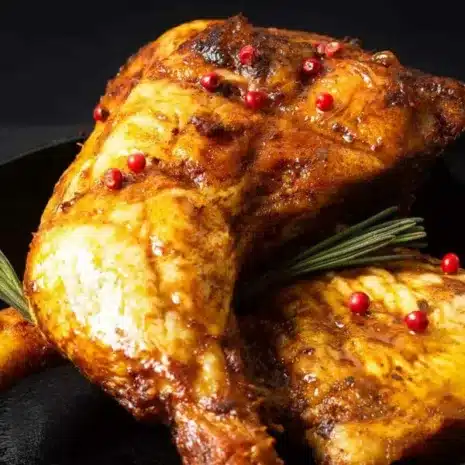
Har cheong gai is a marinade and a method. The marinade is fermented prawn sauce from a jar, cut with ginger juice, sugar and wine, given at least four hours on chicken mid joints. The method is a double fry: one pass to cook the meat through, a rest, then a short hot pass that blisters the coat into the zi char crunch. Get those two right and the home version stands next to the restaurant one.
The usual problem. Home har cheong gai comes out pale and soggy, or it tastes harsh instead of savoury. Pale and soggy is a single fry at the wrong heat. Harsh is too much paste and no time for the marinade to mellow. Neither needs restaurant equipment to fix.
What har cheong actually is
Har cheong is fermented prawn sauce, sold in jars, usually labelled fine shrimp sauce. It is grey-pink, thick like yoghurt, and it smells loud straight from the jar. Do not judge it there. In hot oil the funk mellows into a deep savoury flavour that plain salt cannot reach, and it browns the coating at the same time.
Do not confuse it with belacan, the hard dried block used for sambal. Belacan will not dissolve into a marinade. You want the pourable jarred sauce, and you want less of it than you think: about two tablespoons for 600g of chicken. It is salty, so the marinade needs no extra salt at all.
Why mid joints fry up best
The mid joint is the flat middle section of the wing: two thin bones, a high skin-to-meat ratio, and one even thickness from end to end. That evenness is the whole trick. Every piece in the pot finishes at the same time, so nothing is raw while its neighbour is burnt. The skin crisps into the coating, and the thin bones mean the meat cooks before the crust gets dark.
Drumlets and full wings still work, but they are thicker at one end than the other, so you trade away the evenness that makes mid joints foolproof.
Thaw before you marinate
Frozen mid joints go into the chiller the night before, on a tray on the lowest shelf, and the marinade only goes on once they are fully thawed.1 A marinade cannot get into half-frozen meat, so skipping this step wastes the overnight soak you are about to give it. With no marinade in play, you can cook wings straight from frozen.
The marinade
- 600g chicken mid joints, thawed and patted dry
- 2 tablespoons fermented prawn sauce (fine shrimp sauce)
- 1 tablespoon ginger juice: grate a thumb of ginger and squeeze it
- 1 tablespoon Shaoxing wine
- 2 teaspoons sugar and a good pinch of white pepper
Mix everything with the chicken, cover, and give it at least four hours. Overnight is better: the funk mellows and the flavour gets past the skin into the meat. The bowl lives in the fridge the whole time, never on the counter. SFA calls the range between 5°C and 60°C the temperature danger zone, and a marinating bowl on the counter sits right in it.2
The coating: thin, not thick
Just before frying, crack one egg into the bowl and add three tablespoons of potato starch (cornstarch works) and two tablespoons of plain flour. Mix until every piece wears a thin, clingy coat. You are not building a batter shell. A thick batter turns to bread; a thin coat turns to crackle.
Double-fry for the zi char crunch
- Heat oil to 160°C. No thermometer? Stand a wooden chopstick in the oil: steady small bubbles mean ready.
- Fry the mid joints in batches for five to six minutes, until cooked through but only pale gold. Crowding the pot drops the oil temperature, and that is where sogginess starts.
- Rest the pieces on a wire rack for five minutes. Steam escapes and the crust dries out, which is exactly what the second fry needs.
- Bring the oil up to 190°C and fry again for 60 to 90 seconds, until deep golden and blistered.
- Drain on the rack, not on paper towels. Paper traps steam and softens the crust you just built.
The first fry cooks, the rest dries, the second fry crisps. That is the entire zi char secret, and it also means you can do the first fry an hour ahead, then finish the second fry just as everyone sits down.
Use a neutral oil with a high smoke point, and enough of it that the pieces float free. A small deep pot beats a wide shallow pan: the temperature holds steadier, and the coating seals fast instead of soaking.
Serve it hot
Pile the pieces up, squeeze calamansi or lime over the top, and eat while the crust still crackles. Har cheong gai does not wait well, which has never once been a problem, because it does not last long enough to soften. For the frozen finger food alongside it, air fryer times and temps save the guesswork.
If you must hold a batch, keep it on the rack in a low oven with the door cracked open, never under a cover. A lid is a steam trap, and steam undoes the second fry.
Mid joints were made for this
Even thickness, maximum skin. The cut is half the recipe.
- Singapore Food Agency, Guidelines on Thawing of Food (updated 27 Sep 2024): “Frozen food should therefore not be left to thaw at room temperature, to prevent food poisoning bacteria that may be present from multiplying to high levels. Frozen food is recommended to be thawed in the chiller maintained at a temperature not below 0ºC and not above 4ºC, or by using a microwave oven.” The same document adds: “Check for ice crystals in the food using your hand or a skewer”, and “Cook thawed meat immediately and do not refreeze thawed food.” sfa.gov.sg ↩︎
- Singapore Food Agency, Temperature Control in Cooked Food (Risk at a Glance): “5°C-60°C is known as the “temperature danger zone””, the range food should not be left sitting in. sfa.gov.sg ↩︎