
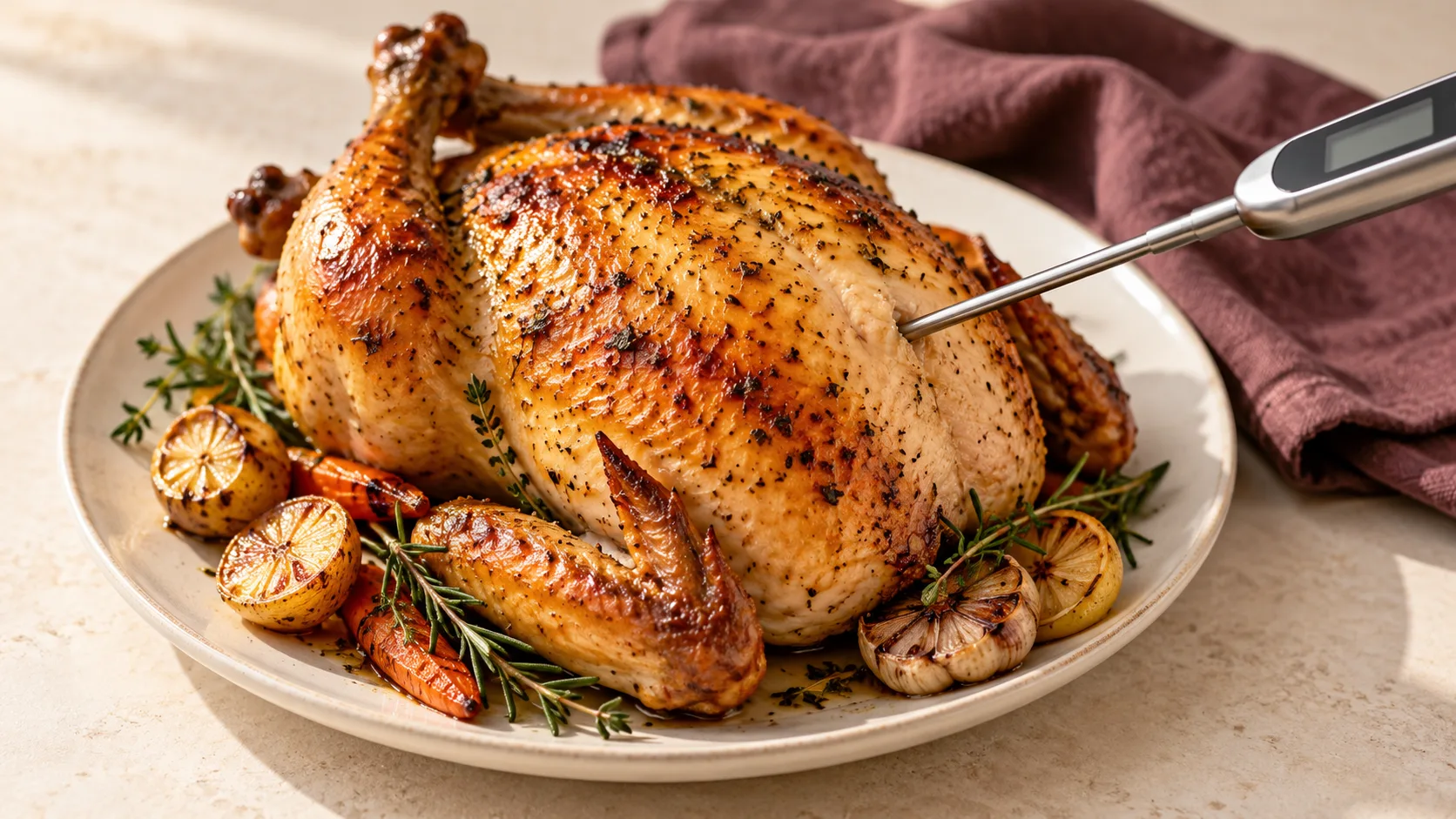
Cover: AI-generated food illustration; no specific seller product is depicted.
Measure the centre of the thickest part, keep the probe away from bone, and check more than one place when pieces differ in size. Browning on the outside is not a reliable measurement of what happened in the centre.
The FDA's Safe Food Handling explains why colour and texture cannot establish meat safety. For Singapore home cooking, SFA's Food Safety Tips recommend thorough cooking at temperatures above 75°C. Use the thermometer to check the food itself, rather than treating an oven setting or a recipe's estimated time as the final result.
Choose a probe that can measure your food
Read the thermometer's instructions before cooking. Find out where its sensing area is, how deeply it must be inserted, how long a stable reading takes, and whether it is intended to remain in the oven. A handheld instant-read probe and an oven-safe leave-in probe do different jobs.
For thin food, the sensing area has to fit inside the food rather than partly measuring the surrounding air or the hot pan. If your probe cannot do that, choose a thermometer suited to thin portions. Do not assume every metal probe has the same sensing area.
Use this check while the food is cooking
- Clean the probe according to its manufacturer's instructions before use.
- Find the thickest part. Insert the sensing area into the centre without touching bone, fat or gristle. This placement follows 4 Steps to Food Safety.
- Keep the tip clear of the pan or grill. Wait for the reading to stabilise as directed by the thermometer maker.
- Check other thick areas or larger pieces. One small piece does not establish the temperature of a larger piece beside it.
- If a reading is below the cooking target, continue cooking and check again with a cleaned probe. Put finished food on a clean plate with clean utensils.
- Clean the probe again after checking, following its care instructions.
The success check is a correctly placed measurement that meets the cooking target throughout the pieces you are serving. A quick reading against a bone or hot tray does not satisfy it.
Adapt the placement to the shape
| Food shape | What to pay attention to |
|---|---|
| Thick boneless meat | Place the sensing area in the centre of the thickest part, rather than just below the browned surface. |
| Bone-in chicken pieces | Measure meat away from the bone; check larger pieces separately. |
| Thin patty | Use a suitable probe from the side so the sensing area lies within the centre. |
| Several unequal pieces | Check the thicker pieces instead of relying on the smallest one. |
The University of Minnesota Extension's Cooking at home describes side-entry measurement for thin food and explains how sensing areas differ between dial and digital thermometers. This approach only works when the probe's instructions and dimensions suit the food.
Use a separate rule for reheating leftovers
For stored cooked food, SFA recommends reheating at 75°C and above for at least two minutes and advises against reheating more than once. Portion leftovers before storage so you can reheat only what you will eat. In a microwave, follow the cooking and standing instructions, cover the food, and check it after the required standing period; the FDA explains that standing time helps colder areas finish heating.
If you are choosing meat for a recipe, match the pack to the method you plan to use. Browse chicken listings and check the seller's cooking instructions; keep the final centre-temperature check as part of your preparation.