
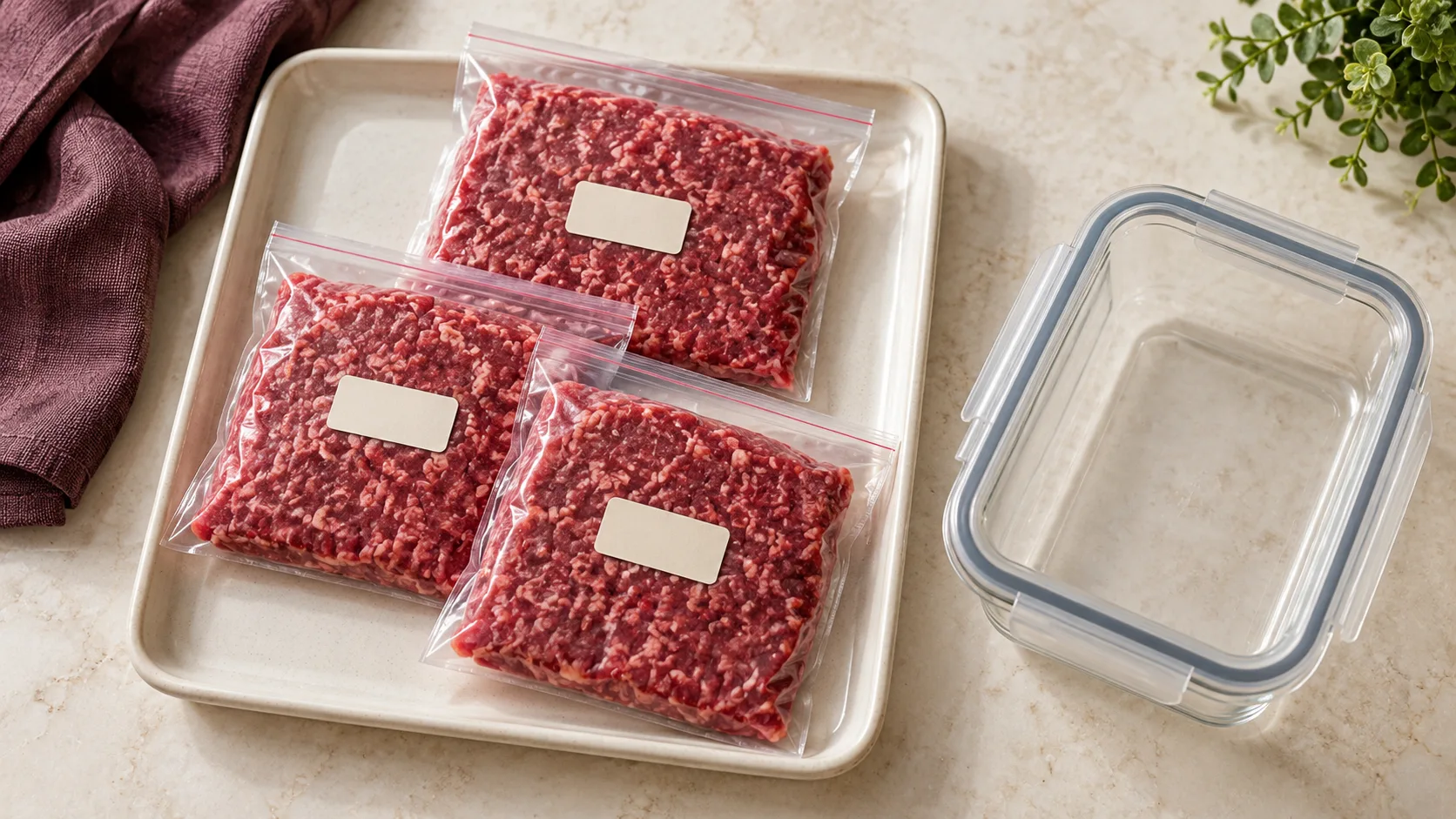
Cover: AI-generated food illustration; no specific seller product is depicted.
If the frozen mince is already loose and separable, take only the amount you need and promptly return the rest to the freezer. If it is one solid block, thaw it safely in the fridge before portioning; do not leave the block on the counter to loosen.
The useful buying distinction is whether the pack gives you separable portions or one block. That changes your preparation plan without changing the need to keep raw meat cold and cook it thoroughly. The Singapore Food Agency's Food Safety Tips recommend a refrigerator at 4°C or below, a freezer at −18°C or below, and particular care with minced meat because mincing exposes it to bacteria.
Check the format before opening
Read the pack's storage and preparation instructions. A listing photograph alone cannot establish whether the contents will separate straight from the freezer. If buying online, ask the seller about the selected variation rather than assuming that every frozen mince pack behaves alike.
Choose a complete recipe and establish the amount it needs before opening the pack. A simple example is a recipe requiring half of a pack: decide how you will store the other half before you begin, rather than discovering a thawed surplus after cooking starts.
When the contents separate while frozen
Use a clean utensil to transfer the required amount into a suitable food-safe container, close the remaining pack securely, and promptly return it to the freezer. Keep any loose raw mince and its juices away from ready-to-eat food. Do not let the whole pack sit out while you prepare the rest of dinner.
Thaw the portion you will cook in a covered container in the refrigerator, or follow a complete cooking-from-frozen method explicitly provided for that product. Free-flowing pieces and a dense frozen block are not interchangeable cooking instructions.
When you have a solid block
- Put the block in a covered food-safe container on a tray in the refrigerator. Keep it below cooked or ready-to-eat foods so raw juices cannot drip onto them.
- Once it has thawed enough to portion without forcing a knife through a hard block, work with clean hands and utensils. Keep preparation brief and return portions to cold storage promptly.
- Cook the amount needed for your recipe. For the remainder, follow any stricter pack instructions. If it was thawed safely in the refrigerator and remains within its safe chilled period, it may be refrozen; another cycle can reduce quality.
- If you instead use cold-water or microwave thawing, cook immediately before cooling and freezing any spare cooked portion. Do not treat those methods as a way to create raw portions for later refreezing.
These thawing and refreezing distinctions are set out in Utah State University's Freezing Basics and the FDA's Safe Food Handling.
Keep the chilled period short
The Cold Food Storage Chart gives raw ground meats and poultry a refrigerator period of 1–2 days at 4°C or below. Follow an earlier label limit, and do not count refreezing as a reset for meat with an uncertain handling history.
Cook the mince thoroughly using a suitable thermometer. SFA recommends temperatures above 75°C. Colour alone cannot establish safe cooking, as the FDA explains: browned crumbs on the surface do not replace a temperature check in the food. Use a probe suited to the portion or dish you are preparing, and clean it according to its instructions.
For your next order, compare beef listings and confirm the mince's pack format with the seller. A meal-sized pack can be a more practical choice than a larger block you will repeatedly need to divide.