
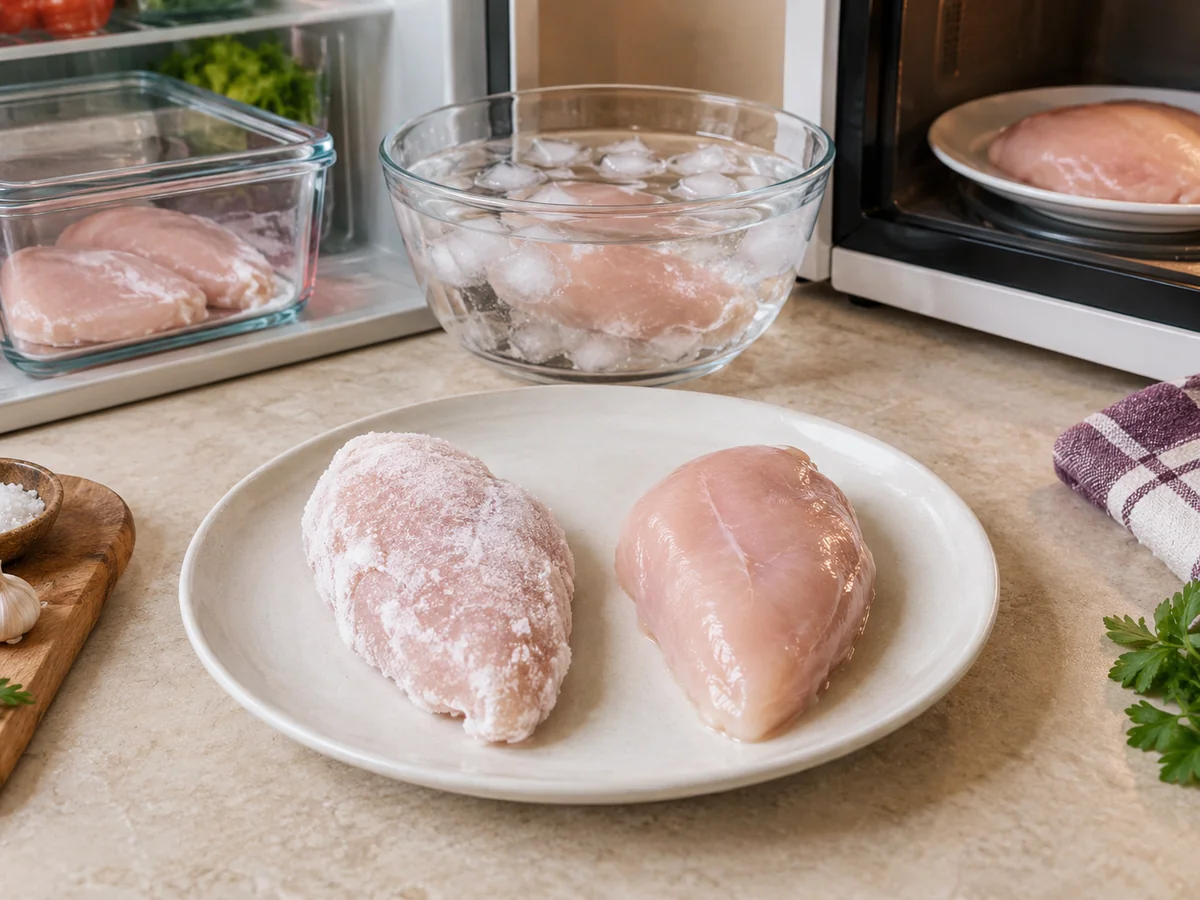
There are three safe ways to defrost chicken breast: the fridge, ice water, or the microwave.1 Room temperature is not one of them, not even for an hour on the counter. Here is how each one works, and how to tell when the chicken is actually thawed.
The usual problem. The counter looks harmless. You are standing right there, it is only a couple of hours, and the middle is still a block of ice. But freezing never killed the bacteria, it only put them to sleep. Warm the chicken up and they wake up and multiply.2 The outside of a chicken breast hits room temperature long before the centre softens, so the part you are waiting on is fine while the part you will eat has been sitting in the danger zone the whole time.
The three methods, side by side
| Method | Speed | Cook it straight after? |
|---|---|---|
| Fridge | Slowest, plan ahead | Soon, not days later |
| Ice water | Faster, needs watching | Yes, immediately |
| Microwave | Fastest | Yes, immediately |
All three keep the chicken cold the whole way, or move it straight to the pan before bacteria get a chance to build up. Whichever you pick, thaw only the amount you are going to cook. If you have wondered what the freezer actually changes, that is a different question from safety.
Method 1: Fridge thawing
Move the chicken breast from the freezer to the fridge and let it thaw slowly. This is the safest of the three, because the chicken never leaves a cold environment. SFA's number for that environment is a chiller not below 0°C and not above 4°C.
- Put it on a plate or in a container so the juices do not drip onto anything else. Lowest shelf, below the cooked and ready-to-eat food.
- This one takes the longest, so move it across well ahead of when you want to cook.
- Once it is thawed, cook it soon. Do not let it sit in the fridge for days waiting.
Method 2: Ice water thawing
Faster than the fridge, and useful when you forgot to plan ahead. The word that matters here is ice. Not cold tap water. SFA's method is ice water held at not above 4°C, with the food sealed in leak-proof packaging.3 Singapore tap water runs nowhere near that, so a tap-water bath is just a slower version of leaving it on the counter.
- Keep the chicken in its sealed packaging, or seal it in a clean leak-proof bag. Never put the meat straight into the sink or into the water bare.
- Submerge the sealed package fully in a container of clean ice water.
- Change the water often. The chicken keeps melting the ice, so the bath needs topping up to stay at or below 4°C.
- Cook it as soon as it is thawed. Do not leave it sitting in the water, and do not put it back in the fridge for later.
Method 3: Microwave thawing
Use the defrost setting, and only if you are cooking the chicken right away.
- Parts of the chicken start to warm up and even begin to cook while other parts are still icy. That is the microwave putting food into the danger zone, which is why the next line is not optional.
- Cook it immediately after. Microwave-thawed chicken does not sit on the counter and does not go back in the fridge for later.
- Stir or turn the food over partway to help it thaw evenly.
How to tell it is actually thawed
Half-thawed chicken is a real problem, not a small one. Frozen or partly frozen meat needs longer cooking, so the outside can look done while the middle never got hot enough to kill anything. SFA's check is simple: feel for ice crystals with your hand or a skewer, and keep thawing until there are none left. For poultry, check that the joints are flexible. Test again right before it goes in the pan. After that, the rest of the job is cooking it so it stays juicy.
What never to do
Never defrost chicken breast on the counter, in the sink, or anywhere else at room temperature. In Singapore that rule bites harder than it does elsewhere, and you can prove it with two numbers. Bacteria grow fastest between 5°C and 60°C. Singapore's overnight low usually does not fall below 23°C to 25°C, and the daytime high sits around 31°C to 33°C.4
So room temperature here is inside the danger zone. All day, all night, all year. There is no cool hour on the counter to take advantage of.
Ten years behind the counter
How to tell if chicken breast has gone bad
No regulator publishes a smell chart, so this part is not a citation, it is what I learned selling frozen meat for ten years. Check before you cook, even when the defrost went fine. Spotting freezer burn is a separate check, done while the meat is still frozen.
- Smell it. Good chicken breast smells like almost nothing. A sour or off smell means bin it.
- Look at it. Dull, faded or grey patches are a bad sign.
- Touch it. It should feel firm and slightly moist, not sticky or slimy.
If any of those are off, do not cook it. When in doubt, throw it out. A chicken breast is cheaper than a bad night.
After defrosting: cook or refreeze?
Cook it soon after it thaws. Thawed raw chicken should not sit around waiting for a plan.
On refreezing, SFA leaves no room to negotiate: “Cook thawed meat immediately and do not refreeze thawed food.” No exception for meat that stayed cold, no exception for a quick thaw. If you cannot cook the lot, cook it all anyway and freeze the cooked meat instead. That is the move, and it also gives you dinner already made.
Buy chicken breast that is easy to defrost safely
Portion size is a safety decision, not just a convenience one. SFA says it plainly for anyone short on chiller space: portion food into smaller quantities before freezing, then thaw only the amount you need.
Individually portioned cuts thaw faster and more evenly than one big frozen block. A single chicken breast portion goes freezer to fridge and is ready to cook the same day, which cuts down the time it spends anywhere near room temperature. A 2kg block cannot do that, and the block is what pushes people to the counter and the tap in the first place.
Portioned cuts, sized for one dinner
Thaw what you need, cook it, done. No block to hack apart, no reason to ever leave chicken on the counter.