
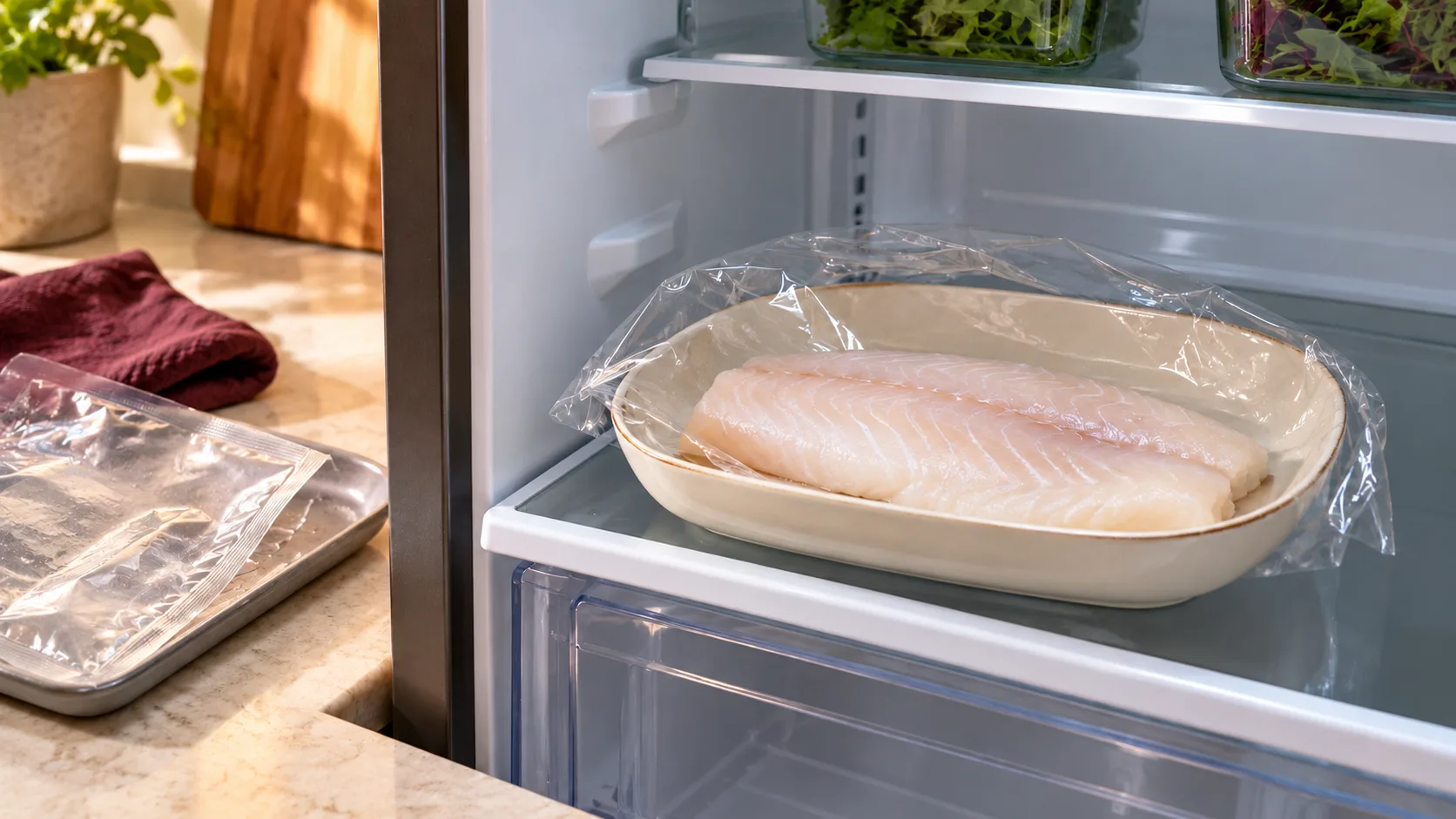
Cover: AI-generated food illustration; no specific seller product is depicted.
Remove frozen fish from its vacuum pouch before thawing it in the refrigerator. Put the fish in a clean dish, cover it without recreating a vacuum seal, and keep it safely chilled. Read the pack's thawing instructions before starting.
NC State Extension's Guide to Freezing and Thawing Seafood at Home specifically warns against refrigerator-thawing seafood inside an unopened vacuum package. Reduced oxygen can create conditions for botulinum toxin formation. The packaging that helps protect a frozen fillet therefore needs a different approach when you thaw it. Florida's food-safety vacuum-packed fish guidance also specifies removing the fish entirely before refrigerator thawing. That handling advice is used here as a safety reference, rather than as a statement of Singapore law.
Recognise the pack you have
A vacuum pouch is drawn tightly around the fish, with much of its air removed. It is different from a loose outer bag holding individually wrapped pieces. Check each inner pack; opening the outer bag does not necessarily open the vacuum pouch around the fish.
Follow the manufacturer's instructions for the exact product. If those instructions are missing or unclear, ask the seller before thawing it. A photograph of a similar fillet is not a substitute for the selected pack's label.
Prepare a refrigerator thawing setup
You need a clean food-safe dish or tray, a loose-fitting cover or suitable food covering, clean utensils, and refrigerator space below cooked or ready-to-eat food. Check with an appliance thermometer that the refrigerator is at 4°C or below. The Singapore Food Agency's Food Safety Tips give that temperature and advise containing raw juices to prevent cross-contamination.
- Read the storage and thawing instructions while the fish is still frozen.
- Open the vacuum pouch and fully remove the frozen fish. Discard the empty pouch; do not reseal it around the thawing fillet.
- Put the fish in the clean dish, loosely cover it, and place it on a tray that can contain any liquid.
- Move it straight into the refrigerator, below cooked and ready-to-eat foods. Do not leave it on the counter while it softens.
- Check the fish when you plan to cook. A thick portion can take longer than a thin one, so allow time rather than using warm water to catch up.
- Cook it promptly according to the pack's instructions and your complete recipe. Keep raw-fish utensils and plates separate from the finished dish.
The FDA's Safe Food Handling also warns against room-temperature thawing and recommends separating raw seafood from other food.
Two packs, two opening steps
Imagine one loose outer bag containing four individually vacuum-packed fillets. To thaw two, leave two frozen in storage. Remove the other two from both the outer bag and their individual vacuum pouches before putting the fish in the covered refrigerator dish.
Now imagine two fillets share one vacuum pouch. Opening that pouch changes the packaging for both. Plan how you will handle both pieces safely rather than assuming you can thaw one side of a sealed pouch while leaving the other untouched. Meal-sized packs can make this simpler for future orders.
If the fish has already thawed inside the pouch
Opening it afterwards does not reconstruct its time and temperature history. Do not use a normal smell or appearance as proof of safety; the FDA's Refrigerator Thermometers guide explains why those checks cannot rule out harmful bacteria. If you cannot establish safe handling, do not eat it. Seek the manufacturer's guidance on the exact product rather than relying on an invented number of safe hours.
For the next meal, compare fish listings and confirm the inner packaging, portion format and thawing instructions with the seller before ordering.