

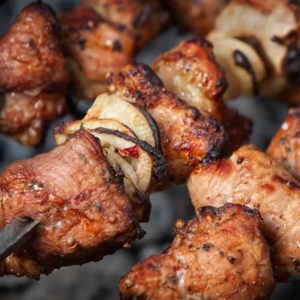
The cut for rendang is shank. It is threaded through with connective tissue that a long braise melts into gelatine, so after three to four hours the meat pulls into soft strands that stay moist even as the coconut milk cooks down to a dark, almost dry sauce. Lean cubes cannot do that. They are dry long before the sauce is ready, and rendang is a dish where the sauce decides when dinner is done.
The usual problem. You followed the recipe, simmered for hours, and still ended with tight, fibrous beef in a good sauce. That is not a technique failure. It is a casting error. The recipe asked for hours of cooking and the cut you bought had nothing left to give after one.
What the long braise does to shank
Shank is the shin: a hard-working muscle wrapped and veined with collagen, the connective tissue that makes it too tough to grill. Slow, moist heat is the key that unlocks it. Held at a gentle bubble for hours, that collagen softens and melts into gelatine, which does two jobs at once. It coats the meat fibres so they eat as silky instead of dry, and it gives the sauce a body that clings to rice.
This is why shank gets better the longer it goes, right up to the point where it falls apart at a spoon. The toughest cut in the case, given time, becomes the most tender thing on the table. Cheap cuts reward patience in general, and knuckle is another that pays back a long pot.
Bone-in slices work too. The bone adds marrow richness to the sauce, and the meat around it behaves exactly the same way. Boneless chunks are easier to portion, so take whichever the freezer offers. Either way, keep the pieces big. Chunks of about 5cm hold together through four hours, while small dice simply disappears into the sauce.
Why lean cuts fail here
Rendang cooks meat far past the point most dishes call done, because the endpoint belongs to the sauce: the coconut milk has to reduce, split and darken before the flavour is right. A lean cube of topside is at its driest exactly when the sauce is at its best. Shank’s schedule matches the dish. Its best hour and the sauce’s best hour are the same hour. Pick the cut whose peak lands at hour three, not hour one. Each beef cut has a method that suits it, and rendang belongs to the slow end.
The rempah shortcut
The spice paste does not need a pestle or a whole afternoon. Blend everything with a splash of oil until smooth:
- 10 dried chillies, soaked in hot water until soft (or 3 tablespoons of chilli paste)
- 8 shallots and 5 garlic cloves
- A thumb each of ginger and galangal
- 2 lemongrass stalks, white parts only
- 1 teaspoon ground turmeric and 1 teaspoon ground coriander
The one extra worth the ten minutes is kerisik: grated or desiccated coconut toasted dry in a pan until deep brown, then pounded or blitzed to an oily paste. It is the nutty backbone of a proper rendang, and skipping it is the difference people can taste but cannot name. The same rempah habits carry over to a mutton curry without the gamey edge.
The braise, hour by hour
- Fry the rempah in three tablespoons of oil over medium heat for about ten minutes, until it darkens and the oil seeps back out around the edges. Undercooked rempah tastes raw all the way to the end, so do not rush this.
- Add 1kg of shank cut into 5cm chunks and turn them until coated.
- Pour in 800ml of coconut milk, then add two bruised lemongrass stalks, four lime leaves, a tablespoon of tamarind paste, a tablespoon of gula melaka and a teaspoon of salt.
- Hours one and two: keep it at a lazy bubble, uncovered, stirring every 20 minutes or so. The sauce will slowly darken from cream to caramel.
- Hour three: stir in the kerisik. The sauce is thickening now, so stir more often and scrape the bottom each time.
- The last half hour: the oil splits out, the sauce turns deep brown and clings to the meat, and a chunk should yield to a spoon with no argument. Stop earlier, while it is still saucy, and you have kalio, the wetter cousin. Keep going for true dry rendang.
Timing, thawing, and why tomorrow tastes better
Budget three and a half to four hours at the stove, nearly all of it hands-off. Frozen shank is thick, so it needs a full day in the chiller: put it on a tray on the lowest shelf, and thaw only what the pot will take.1 Press the centre of each piece before it goes in: any firmness at the core means it needs more time.
Rendang is also one of the rare dishes that improves overnight, as the gelatine and spices settle into the meat. Cook it a day ahead on purpose. Once it stops steaming, get it into the fridge promptly rather than leaving the pot out.2 Reheat it gently with a splash of water, and serve it with rice, or the way it disappears fastest in this house: spooned over toasted bread.
The cut is the recipe
Shank carries the collagen the braise needs. Everything else is patience.
- Singapore Food Agency, Guidelines on Thawing of Food (updated 27 Sep 2024), on chiller thawing: plan for a refrigerator or chiller “maintained at a temperature not below 0°C and not above 4°C”, thaw raw food on the lowest shelf on a tray to prevent drippings reaching other food, and “Thaw only the amount of food you require for cooking.” sfa.gov.sg (PDF, p.2) ↩︎
- Singapore Food Agency, Temperature Control in Cooked Food (Risk at a Glance): for cooked food kept for later, the advice is to “quickly refrigerate at 4°C or lower”. sfa.gov.sg ↩︎