
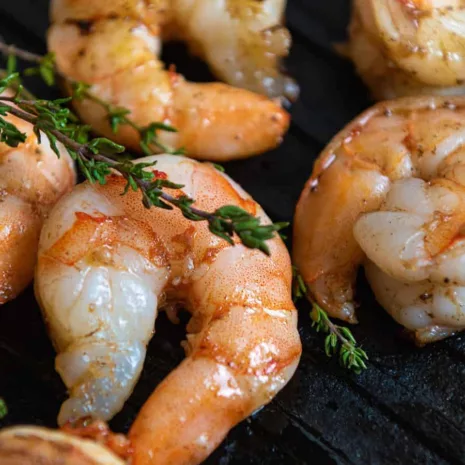
Frozen scallops brown the same way fresh ones do, on three conditions. Thaw them all the way, dry them until a paper towel pressed on top comes away dry, and set them into a pan that is properly hot, then leave them alone. Browning is a dry-surface event. Every drop of water on the scallop has to boil off before a crust can start, and a crowded pan of wet scallops never gets there. It steams, the scallops turn grey and bouncy, and the golden crust never comes.
The usual problem. The scallops went into the pan straight from the thawing bowl, still damp. Thirty seconds later they are sitting in a puddle of their own water, boiling instead of browning. By the time the puddle cooks off, the scallops are overdone. The fix starts ten minutes before the pan.
Why frozen scallops steam
Frozen scallops carry more surface water than almost anything else you will ever sear. There is the ice glaze packers add to protect them in the freezer, the moisture from thawing, and the water the flesh itself weeps as it warms. Some packs are also treated to hold extra moisture, and those weep the most in the pan. Frozen clams carry the same glaze, and keeping them plump is its own job.
A pan cannot do two jobs at once. While the surface is wet, the heat goes into boiling water, and the temperature at the scallop’s face stays stuck near boiling point. Crust chemistry needs the surface far hotter than that. Dry the scallop and the same heat goes into browning instead. That is the entire difference between golden and grey.
Thaw fully first
A frozen-solid scallop cannot sear. The outside overcooks while the core thaws in the pan, and the melting ice floods everything around it. Thaw before you sear, one of two ways.
- Slow: the chiller, overnight, in a bowl on the lowest shelf. Best texture, zero attention needed.
- Fast: a sealed leak-proof bag submerged in ice water, with the water changed so it stays cold. This is SFA’s fast method, and it thaws scallops in well under an hour.1
Skip the counter and skip warm water. Room-temperature thawing is the one SFA warns about directly,2 and warm water part-cooks the outside of the scallop before the pan ever sees it. Before you move on, press the thickest scallop: if you feel ice crystals inside, keep thawing until you do not.3 Prawns thaw by the same rules, and a rushed job leaves them rubbery.
Dry them like it matters
- Tip the thawed scallops onto a double layer of paper towels.
- Press a second towel on top. Press, do not rub. Swap in fresh towels until one comes away dry.
- If you have fifteen minutes, park them on a rack in the chiller, uncovered. Chiller air is dry and pulls off the last of the surface moisture.
- Salt at the last minute only. Salt pulls water to the surface, so season on the way to the pan, not before.
The no-touch sear
- Use a heavy pan. Cast iron or stainless steel holds its heat when the scallops land; a thin pan gives it all up in the first ten seconds.
- Add a high smoke-point oil and heat until it shimmers and just begins to wisp. If the first scallop does not sizzle hard on contact, take it out and let the pan keep heating.
- Place the scallops in clockwise from twelve o’clock, with clear space between each one. If they do not all fit with space, cook two batches.
- Now do not touch them. Ninety seconds to two minutes, until a deep golden rim creeps up the sides. A scallop that resists a gentle nudge is not ready. It releases on its own when the crust is set.
- Flip once. The second side needs only 30 to 60 seconds. A knob of butter added at the flip, spooned over the tops, finishes them.
- Pull them when the sides have turned opaque but the very centre still looks barely translucent. They keep cooking on the plate for another minute.
If you want a doneness check without cutting one open, use your hand. Press the top of a scallop with a finger: raw feels soft and wet, done feels like the base of your thumb when your hand is relaxed, springy but no longer squishy. Firm and tight means it went too far. Rest the batch for a minute on a warm plate before serving, and pour any butter from the pan over the top rather than putting the scallops back in it. The same pan does frozen fish, though some fish suit steaming or soup better.
Mistakes that bring the steam back
- Crowding the pan. The water vapour has nowhere to go and you are steaming again. Two golden batches beat one grey one.
- A pan that was almost hot. Almost hot boils, properly hot browns.
- Flipping early and often. The crust needs unbroken contact with the metal. One flip, total.
- Searing them wet because dinner was rushed. Five minutes with the towels does more for the crust than anything you can do once the pan is on.
Scallops worth drying properly
Thick, sweet scallops from the freezer sear as well as the restaurant kind. The towels and the hot pan do the rest.
- SFA, Guidelines on Thawing of Food (updated 27 Sep 2024), “Thawing by Submerging in Ice Water”: “Place food to be thawed in a clean leak-proof packaging. Submerge the package in a container of clean ice water with frequent change of water to ensure that the temperature of the ice water is kept at not above 4°C, as the food continues to thaw. Do not place food directly in the sink or into container of water without packaging it.” sfa.gov.sg (PDF, p.3) ↩︎
- Singapore Food Agency, same guidelines: “Frozen food should therefore not be left to thaw at room temperature, to prevent food poisoning bacteria that may be present from multiplying to high levels.” sfa.gov.sg (PDF, p.1) ↩︎
- SFA, same guidelines: “Check for ice crystals in the food using your hand or a skewer. If food is not fully thawed, continue to thaw the food until no ice crystals are present. Test again before cooking or reheating.” sfa.gov.sg (PDF, p.1) ↩︎