
Beef knuckle is a lean cut from the round, the hard-working muscle group in the hind leg. It is one of the cheapest cuts in the beef freezer, and it earns its keep in three jobs: clear soups, slow stews, and thin-sliced stir-fry. Cooked the right way, it eats far above its price. Cooked like a steak, it will chew back.
The usual problem. You spot a beef tray at a fraction of the ribeye price and take the win. Then you pan-fry it thick, and dinner is grey and tough. The meat was never the problem. Knuckle is a working muscle. It wants moist heat or a thin slice, not a hot sear on a fat slab.
What beef knuckle actually is
The knuckle sits in the round, the big ball of muscles above the back knee. Those muscles carry the animal all day, so they are packed with collagen, the tough connective tissue that only softens with heat and moisture together.1 Marbling is close to zero. In some shops the same cut is labelled round tip or sirloin tip. Whatever the sticker says, you can spot it by the look: a pale, dense, almost fat-free block.
Lean has an upside people forget. There is no fat cap to trim away and no bone to pay for. Nearly every gram on the scale is meat that ends up on a plate.
Why it costs so little
Beef pricing follows tenderness, not flavour. Cuts you can sear rare command steak money. Cuts that need time get priced like homework. Knuckle needs time, so it stays cheap. That is the whole trade: your pot does the work that expensive marbling would have done, and you keep the difference. Every other cut prices the same way, and each one wants its own method.
The three jobs it does well
| Dish | How to cut it | Why knuckle works |
|---|---|---|
| Clear soup | Chunks or thick slices | Lean meat keeps the broth clean, not greasy |
| Stew and curry | Cubes around 3cm | A long simmer melts the collagen into the sauce |
| Stir-fry | Slices 2 to 3mm, across the grain | A thin slice cooks through before it can toughen |
Soup. For beef noodle soup or a clear radish soup, knuckle gives you meat that holds in neat pieces and a broth that barely needs skimming. Keep the simmer gentle. A rolling boil tightens lean meat faster than it softens it. Add the meat early so it feeds the pot, not at the end like a garnish.
Stew. This is where the cheap cut punches hardest. Give the cubes 90 minutes to two hours at a bare simmer and the collagen turns to gelatine, the change that makes any working cut worth braising. The meat goes tender, and the sauce picks up a body that lean quick-cook cuts can never give it. Rendang, beef curry, red-braised beef: knuckle takes all of them.
Stir-fry. For the wok, cut thin and cut across the grain. The old trick makes this easy: slice while the block is still partly frozen, when the meat is firm enough to shave into even ribbons.2 A short marinade with a spoon of cornflour helps the slices hold their moisture over the flame. Ginger and spring onion beef, black pepper beef, chilli beef: knuckle handles them all for far less than the usual cuts.
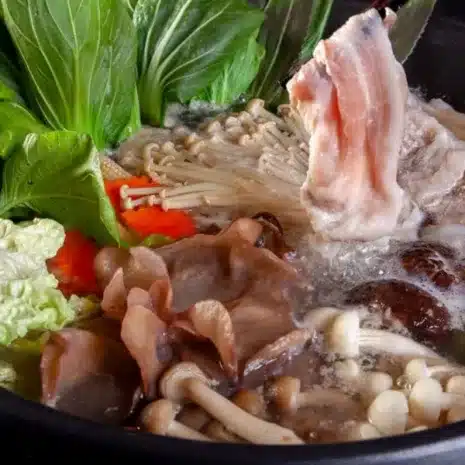
Bonus job: the steamboat. The same thin slices that work in the wok work in a hotpot. Swish a ribbon of knuckle through hot broth for ten seconds and it comes out tender, because at that thickness there is nothing left to fight. If your household does steamboat nights, one portioned block covers both dinners.
Where it lets you down
Skip knuckle for steaks, for roasts you want pink, and for anything cooked hot and fast in thick pieces. With so little fat inside, a thick piece has no buffer. It goes from raw to dry with nothing pleasant in between. If steak night is the plan, buy a steak cut, and let knuckle do the jobs above. The same warning covers the oven: a lean roast pushed past pink turns into cardboard slices that no gravy can rescue.
Buying and prep notes
- Trim the silver skin, the thin pearly membrane on the outside. It never softens, no matter how long you cook.
- Portion the block before it goes into your freezer: stew cubes in one bag, stir-fry slices in another. Thaw only the bag you need.
- Cut across the grain every time. Along the grain, even tender meat chews long.
- Keep the offcuts for the stock pot. Lean scraps make clean beef stock.
Before it hits the pot
Thaw knuckle in the chiller, never on the counter. SFA is direct: frozen food should not be left to thaw at room temperature, and the chiller should hold between 0°C and 4°C.3 Slicing the block while it is partly frozen is fine. Cooking it partly frozen is not, because a cold core throws off every timing in the pot. Check for ice crystals with a skewer, cook once thawed, and do not refreeze.
Cheap cut, big pot, better dinner
Knuckle rewards the cook who gives it time. Sliced thin or simmered slow, it is the best value in the beef freezer.
- Seasoned Advice (Cooking Stack Exchange), accepted answer to “Why did my roast beef turn out chewy and not tender? Where did I go wrong?”: “Working cuts have to exert a force, so the muscle must have lots of collagen to distribute the force from the tendon throughout the muscle. Collagen is a tough material which breaks down in the presence of heat and moisture, not just heat, so working cuts make poor roasts or steaks and are better braised or stewed.” The same answer notes the collagen “when broken down by moisture turns to gelatin which adds to the flavor and mouth feel”, and names round (topside and silverside in the UK, Australia and New Zealand) as a working cut. cooking.stackexchange.com ↩︎
- Seasoned Advice (cooking.stackexchange.com), accepted answer on choosing and slicing beef for sukiyaki: “To thinly slice meat, put it in the freezer first until it just starts to get hard (not even close to fully frozen), or start with meat that is only partially defrosted. Partially frozen meat is much easier to neatly and thinly slice.” cooking.stackexchange.com ↩︎
- Singapore Food Agency, Guidelines on Thawing of Food (updated 27 Sep 2024): “Frozen food should therefore not be left to thaw at room temperature, to prevent food poisoning bacteria that may be present from multiplying to high levels. Frozen food is recommended to be thawed in the chiller maintained at a temperature not below 0ºC and not above 4ºC, or by using a microwave oven.” The same document adds: “Check for ice crystals in the food using your hand or a skewer”, and “Cook thawed meat immediately and do not refreeze thawed food.” sfa.gov.sg ↩︎