
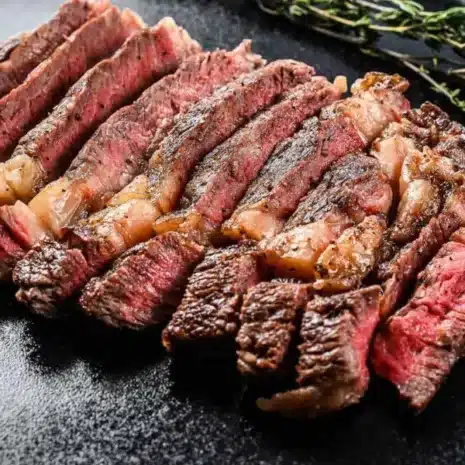
Ribeye is the cut most Singapore steamboat pots are built around. The fat runs right through the muscle, so a slice cut thin enough to see light through cooks in seconds and comes out tender. Here is how to slice it, thaw it safely, and cook it right.
The usual problem. Dinner is at seven, so the ribeye comes out onto the counter to thaw. It is soft by the time you slice it, so the slices come out thick and ragged. Then they go into a pot at a rolling boil and turn grey and chewy. Three mistakes, none of them the meat’s fault. The counter one matters most: freezing does not kill bacteria, it only makes them idle, and they start multiplying again as the meat warms up.1
What makes ribeye right for shabu-shabu
Ribeye carries its fat as marbling through the whole muscle, not as a cap on one side. That marbling melts in hot broth in seconds, which is why a paper-thin slice goes tender instead of chewy. It is also the muscle the US grading system reads marbling from, ribbed between the 12th and 13th ribs.2 Leaner cuts like topside behave differently in the same pot. They go firm where ribeye goes tender. If you are weighing ribeye against tenderloin for a steak night, that marbling is the whole argument.
How thin to slice it
Shabu-shabu means “swish swish”, the sound the meat makes going through the broth. For that swirl-and-eat speed, aim for slices about 2 to 3mm thick, thin enough to see light through them.
- Slice it part-frozen. Meat that is just firm cuts thinner and more evenly than soft meat. Put it back in the freezer until it only starts to go hard, not frozen solid, then slice.3 Go by feel, not by the clock. Every freezer is different.
- Slice against the grain, across the muscle fibres, for the most tender bite.
- A sharp knife beats a fancy one. A dull blade tears a thin slice instead of cutting it.
Thawing it safely before you slice
Move the ribeye from the freezer to the fridge the night before. That is the method SFA recommends, a chiller held not below 0°C and not above 4°C, and it asks nothing of you except remembering the night before.4 Never the counter.
- Short on time? Seal it in a clean leak-proof bag and submerge it in ice water, changing the water often enough to keep it at 4°C or below. Ice water, not cold water from the tap.
- Once it is thawed, cook it. Thawed raw meat does not go back in the freezer.
- Thaw it low in the fridge, on the bottom shelf or below anything cooked, on a tray. That stops drips landing on food nobody is going to cook again.
- Keep raw slices on their own plate, away from anything cooked, and use a separate pair of tongs or chopsticks for the raw meat.
- Wash your hands and the board after handling raw meat, before you touch anything else.
Setting up the pot
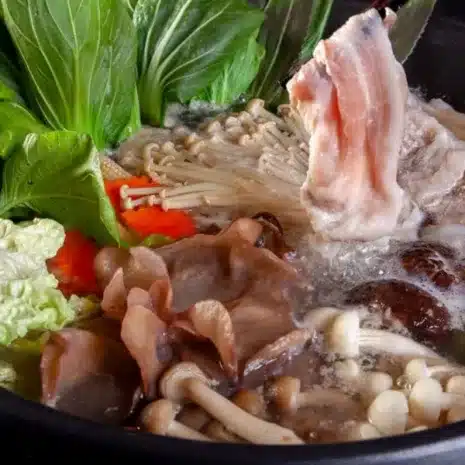
Shabu-shabu broth stays plain on purpose. The meat carries the flavour, not the broth. The usual options are a kombu dashi (dried kelp simmered until the water turns pale gold), a light chicken broth, or a split pot with a spicy side and a mild side for the table to share.
Keep the broth at a steady simmer, not a rolling boil. A hard boil toughens thin-sliced meat and clouds the broth.
Cooking it right
Hold a slice with chopsticks and swirl it through the simmering broth for a few seconds, until the red turns to an even brown and no pink is left. SFA is blunt about this one: meat that is still pink is not cooked through.5 Ribeye’s marbling keeps it juicy even fully cooked, so there is nothing to gain by pulling it out early. Straight into your bowl, eat it hot. That is the whole method.
Sauces and sides that work
In the dipping bowl
- Ponzu with grated daikon, to cut through the fat
- Sesame sauce (goma dare), to play up the richness
- Chopped scallion and chilli oil, for a Sichuan-style pot
In the pot
- Napa cabbage
- Enoki mushrooms
- Tofu
- They go into the same broth and pick up flavour from the meat that has already swirled through it
Storing what’s left
Cooked leftovers go into a sealed container in the fridge and get eaten within a few days. Raw ribeye that thawed but never made it into the pot stays in the fridge, in the coldest part, and does not go back into the freezer. Working out how much meat per person before you shop leaves less to store.
Get the cut this pot is built on
Marbled through the middle, sliced thin. That one choice is the difference between tender in three seconds and grey and chewy.
- Singapore Food Agency, Guidelines on Thawing of Food (updated 27 Sep 2024): “When food is frozen at 0°C and below, some of the bacteria found in the food may be inactive but are still alive. When frozen food is thawed, its core temperature rises and bacteria may start to be active again and multiply.” sfa.gov.sg ↩︎
- United States Department of Agriculture, United States Standards for Grades of Carcass Beef: “The marbling and other lean flesh characteristics specified for the various grades are based on their appearance in the ribeye muscle of properly chilled carcasses that are ribbed between the 12th and 13th ribs.” This says the ribeye is the muscle the US system reads marbling off. It is not a ranking of ribeye against other cuts. ams.usda.gov ↩︎
- Seasoned Advice (cooking.stackexchange.com), accepted answer on choosing and slicing beef for sukiyaki: “To thinly slice meat, put it in the freezer first until it just starts to get hard (not even close to fully frozen), or start with meat that is only partially defrosted. Partially frozen meat is much easier to neatly and thinly slice.” cooking.stackexchange.com ↩︎
- Singapore Food Agency, Guidelines on Thawing of Food: “Frozen food should therefore not be left to thaw at room temperature, to prevent food poisoning bacteria that may be present from multiplying to high levels. Frozen food is recommended to be thawed in the chiller maintained at a temperature not below 0ºC and not above 4ºC, or by using a microwave oven.” On ice water: “Submerge the package in a container of clean ice water with frequent change of water to ensure that the temperature of the ice water is kept at not above 4˚C, as the food continues to thaw.” And on refreezing: “Cook thawed meat immediately and do not refreeze thawed food.” sfa.gov.sg ↩︎
- Singapore Food Agency, Food Safety Tips: “Food such as meat and poultry should be cooked thoroughly, with juices running clear when pricked or sliced. Meat that is pink indicates that it is not cooked thoroughly.” sfa.gov.sg ↩︎