
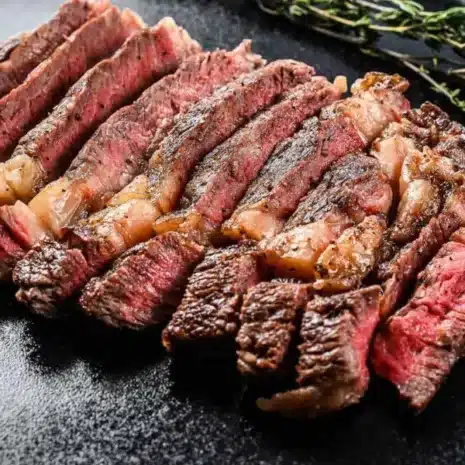
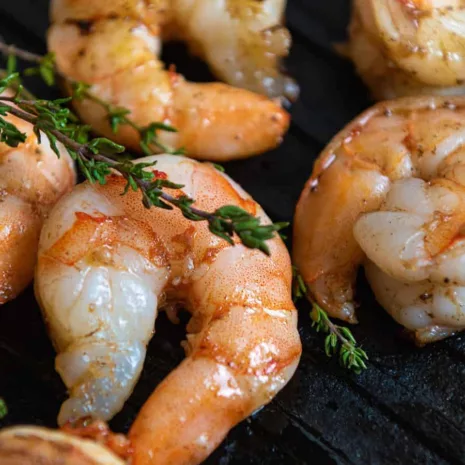
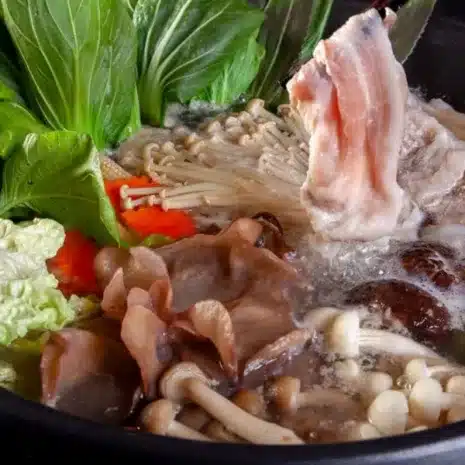
Plan 200 to 250g of sliced meat per adult when steamboat is the whole meal, plus 100 to 150g of seafood, four to six balls or dumplings, and a serving of vegetables and noodles each. Count children as half an adult. Big eaters get 300g. The checklist below turns those numbers into a shopping list you can carry into the freezer aisle.
The usual problem. Steamboat shopping fails in two directions. Buy short and the pot dies an hour in with everyone still hungry. Buy long and the night ends with a bowl of thawed meat you cannot put back in the freezer, because thawed food should not be refrozen.1 Counting grams per head fixes both.
The per-person numbers
Work from this table, then adjust with the rules in the next section. The weights are raw weights as they read on the pack. The same numbers hold if you slice your own meat from a frozen block.
| Per adult | Per child | Note | |
|---|---|---|---|
| Sliced meat (beef, pork or chicken) | 200 to 250g | 100g | Go 300g for big eaters |
| Seafood (prawns, fish slices, squid) | 100 to 150g | 50 to 75g | Prawn weights include the shell |
| Balls and dumplings | 4 to 6 pieces | 3 to 4 pieces | Filling, so they quietly end appetites |
| Vegetables and mushrooms | 150 to 200g | 100g | Leafy greens cook down to little |
| Noodles or rice | 1 serving | Half | Cook them last, in the finished broth |
These numbers assume steamboat is dinner, not a starter. If the pot follows a barbecue or shares the table with a spread of sides, drop the meat to 150g per adult and keep the rest as they are.
What the numbers assume
The table assumes a mixed table: some meat lovers, some seafood people, everyone eating a bit of everything. It also assumes a broth worth drinking and at least one dip, because a good broth stretches the food. People slow down when the soup itself deserves a bowl.
It does not assume leftovers. Trays you never thawed simply stay in the freezer for another meal. Thawed meat does not get that second chance, so the aim is to land close and keep one unopened pack in reserve rather than thawing everything at the start.
How the numbers move
A long dinner eats more than a fast one. If the table will sit and graze past the two hour mark, add a quarter more across the board. Teenagers count as adults, and a table of teenagers deserves one extra tray of meat on top of the maths.
If half the group prefers seafood, move grams from the meat line to the seafood line instead of adding both. The total stays around 300 to 400g of protein per adult; only the split changes. On the seafood line, black tiger or vannamei prawns is the next decision.
Buying for ten or more
Past ten people, stop scaling the variety and start scaling the trays. Keep the same three proteins and buy more of each; a second pot helps the table more than a fourth meat. If you only have one burner, run two sittings rather than crowding one pot. A mobbed pot never comes back to a boil, and everything in it poaches in lukewarm broth.
Round up on meat, round down on extras. When a tray feeds slightly more than the maths says, the slack disappears into second helpings. Spare packs of balls and noodles are cheap insurance, and unopened they keep for the next gathering.
A worked example for six
Four adults and two children, steamboat as the whole dinner:
- Sliced meat: 4 x 225g plus 2 x 100g comes to 1.1kg. Buy three 400g trays and call it 1.2kg.
- Seafood: 4 x 125g plus 2 x 60g comes to about 620g. One pack of prawns plus one pack of fish slices covers it.
- Balls and dumplings: about 28 pieces. Buy 30 and keep the spare pack unopened.
- Vegetables and mushrooms: about 1kg all in, plus a pack of enoki because someone always asks.
- Noodles: five servings, cooked at the end in the broth the whole meal built.
The buying checklist
- Count heads first: adults at one share, children at half, teenagers at one.
- Work in grams, not trays. Pack sizes differ, and the sticker weight is the only number that adds up.
- Pick three proteins, not six. A crowded pot cooks worse, and every extra open pack is one more thing to finish.
- Buy balls and dumplings by piece count, four to six per adult, and keep one unopened pack in reserve.
- Thaw only what the count says. The reserve pack stays frozen until a pot actually needs it.
- Cook noodles last. They drink the broth at its best and stop anyone leaving hungry.
The night before
Move the trays from freezer to chiller the evening before and let them thaw fully. SFA says frozen food should not be left to thaw at room temperature, and puts the chiller range at 0°C to 4°C.2 Bring the meat to the table last when you set up, since slices that are still chiller-cold separate cleanly instead of tearing.3 If beef is the centre of the table, ribeye shabu-shabu at home covers the pot itself.
Shop the pot by the numbers
Sliced meats and steamboat staples, portioned in trays so the maths on this page carries straight to checkout.
- Singapore Food Agency, Guidelines on Thawing of Food (updated 27 Sep 2024): “Cook thawed meat immediately and do not refreeze thawed food. Improper handling and refreezing of food may lead to the growth of bacteria.” The same guidance adds: “Thaw only the amount of food you require for cooking.” sfa.gov.sg (PDF) ↩︎
- Singapore Food Agency, Guidelines on Thawing of Food (updated 27 Sep 2024): “Frozen food should therefore not be left to thaw at room temperature, to prevent food poisoning bacteria that may be present from multiplying to high levels. Frozen food is recommended to be thawed in the chiller maintained at a temperature not below 0ºC and not above 4ºC, or by using a microwave oven.” The same document adds: “Check for ice crystals in the food using your hand or a skewer”, and “Cook thawed meat immediately and do not refreeze thawed food.” sfa.gov.sg ↩︎
- The sliced meats this checklist counts in grams: our shabu-shabu selection. ↩︎