
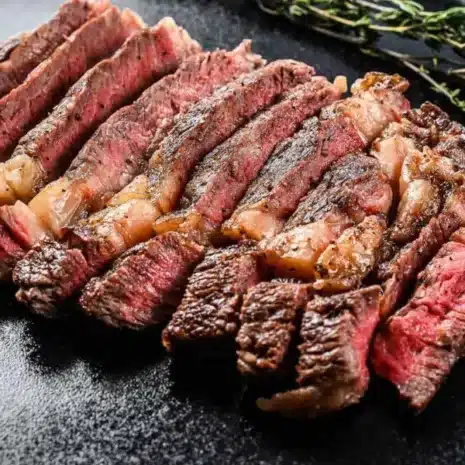

Meat slices paper-thin only when it is semi-frozen. Let the block soften in the chiller until a knife tip can get about a centimetre in, then slice across the grain at 1.5 to 2mm with your longest, sharpest knife. That is the whole trick. Fully thawed meat squashes and tears under the blade. A rock-hard block will not take a knife at all. The narrow window between the two is where every hotpot shop’s slicing machine lives, and your chiller can put you in the same window for free.
The usual problem. You tried slicing your own hotpot meat once, got thick ragged pieces, and went back to pre-sliced packs. The meat was at the wrong temperature, not your knife skills. Pre-sliced shabu rolls charge you for the slicing. A whole block of the same cut costs less per kilo, and fifteen minutes of knife work is all that separates the two.
Why semi-frozen is the whole trick
Soft, fully thawed meat is mostly water held in loose muscle fibre. Press a blade into it and the surface compresses, drags, and tears before it cuts. You cannot get a 2mm slice out of something that squirms away from the knife.
Semi-frozen meat behaves differently. The ice inside holds the fibres stiff, so the block cuts less like flesh and more like firm cheese. The knife glides through in one stroke and the slice holds its shape. Restaurant slicing machines run on frozen blocks for exactly this reason. Your kitchen version is the same idea with a knife. The payoff is ribeye shabu-shabu at home for the price of a block.
Getting the block to the right firmness
Move the block from the freezer to the chiller and let it soften part of the way. A flat block a couple of centimetres thick usually needs a few hours. A thicker block can need most of a day. Keep it in the chiller the whole time: SFA’s thawing guidance is blunt about never leaving frozen food out at room temperature,1 and the chiller keeps the meat between 0°C and 4°C from start to finish.2
You are looking for two signals:
- A knife tip pushed into the side goes in about a centimetre with firm pressure, then meets solid resistance.
- Your thumb dents the surface slightly, but the middle of the block still feels hard.
Softened too far? Put the block back in the freezer for 20 to 30 minutes to firm the surface again. That is a mid-prep firm-up on meat that never left the cold chain, not refreezing for storage. Once the meat is fully thawed, it is on a one-way trip to the pot.
The method is the same for any boneless cut you would swish: beef ribeye or brisket, pork collar or belly, even chicken breast for the cautious end of the table. Fat-streaked cuts are the most forgiving, because the fat stays soft at chiller temperature and the slice bends instead of cracking. Between the two steak cuts, ribeye or tenderloin comes down to fat, and fat helps here.
The knife, the angle, the cut
- Use your longest knife, freshly sharpened. Length matters more than brand: a long blade finishes the slice in one pull instead of three saws.
- Slice across the grain. Find the direction the muscle fibres run and cut perpendicular to them, so each slice is tender instead of stringy.
- Angle the blade about 45 degrees into the block. The slanted cut gives you wider ribbons from a narrow block, closer to what the pre-sliced rolls look like.
- Pull, do not saw. One long drawing stroke per slice. Aim for 1.5 to 2mm, thin enough that the slice droops over the blade.
- Lay the slices flat on a chilled plate as you go, and wipe the blade every few slices so it keeps gliding.
The first three slices are practice. By the tenth you will be in rhythm, and a 500g block turns into a full platter in about fifteen minutes. How many blocks you buy depends on how much meat per person you are planning for.
What the savings look like
Pre-sliced shabu-shabu packs are priced for convenience. You pay for the slicing machine, the labour, and the rolled presentation, on top of the meat itself. Buy the same cut as a frozen block and you pay for meat, not machine time. The gap per kilo varies by cut, but it is rarely small, and it compounds every hotpot night.
There is a second saving people miss: control. One block can be sliced three ways in one session. Paper-thin at 1.5mm for swishing in the pot, about 3mm for the grill plate, and thick strips for skewers. Pre-sliced packs lock the whole meal into one thickness.
Before it hits the pot
Slice, then cook in the same session. Slices this thin finish in hot broth in seconds, so there is no reason to hold them raw. If you sliced more than the table can eat, cook the extras anyway and chill them cooked. SFA’s line on this is short: cook thawed meat immediately, and do not refreeze thawed food.3
Slice it yourself, keep the difference
One frozen block, one sharp knife, fifteen minutes. That is shabu-shabu night at pre-sliced quality without the pre-sliced price.
- Singapore Food Agency, Guidelines on Thawing of Food (updated 27 Sep 2024): “Frozen food should therefore not be left to thaw at room temperature, to prevent food poisoning bacteria that may be present from multiplying to high levels.” sfa.gov.sg (PDF, p.1) ↩︎
- SFA, same guidelines, on chiller thawing: plan for a refrigerator or chiller “maintained at a temperature not below 0°C and not above 4°C”, thaw raw food on the lowest shelf on a tray to prevent drippings reaching other food, and “Thaw only the amount of food you require for cooking.” sfa.gov.sg (PDF, p.2) ↩︎
- SFA, same guidelines: “Cook thawed meat immediately and do not refreeze thawed food. Improper handling and refreezing of food may lead to the growth of bacteria.” sfa.gov.sg (PDF, p.1) ↩︎