
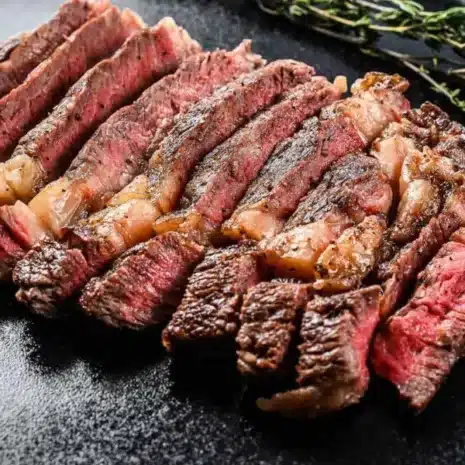

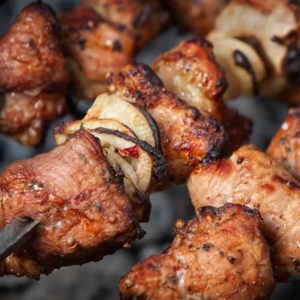
Pork belly is the better mookata default. Its fat cap melts down the dome and bastes the meat as it cooks, so it stays juicy even if you look away for a minute. Pork shoulder is leaner and needs closer attention, but it is the right pick if you want more meat and less fat on your plate.
The usual problem. You grab whichever pork tray looks good, drop it on the dome straight from the packet, and half of it comes off dry or grey in the middle. Neither is a marinade problem. Both come from the cut you picked and whether it was thawed before it hit the heat.
Why the dome changes the answer
Mookata is a Thai-style grill that Singapore made its own: a domed cast iron plate on top, a moat of broth around the base. Fat from the meat on the dome drips down into the moat, where it flavours the soup, vegetables, and noodles underneath. That setup rewards cuts with real fat content, and it punishes cuts that dry out fast.
This is the main reason belly and shoulder behave so differently on the same grill.
Pork belly on the dome
Pork belly has alternating layers of fat and meat. On a hot dome, the fat renders slowly and coats the meat in its own oil. Slice it thin, about 3 to 4mm, and it cooks in under two minutes a side. The fat that runs off adds body to the moat broth, so the vegetables you cook later taste better too.
The tradeoff: belly is rich. A little goes further than you’d think, and a plate that’s all belly can feel heavy by the third round. The rest of the slab earns its keep braised in soy sauce the next day.
Pork shoulder on the dome
Pork shoulder, sometimes sold as pork collar or Boston butt depending on how it’s cut,1 has far less fat marbled through it. It has more chew and a firmer bite. Because it has less fat to self-baste, it dries out faster on a hot dome if left too long.
Two fixes for that: slice it thinner than you would belly, or marinate it first with something simple like garlic, soy sauce, and a little sugar. A short marinade adds the moisture the cut doesn’t have on its own.
Fat, smoke and flare-ups
Belly fat renders fast and most of it runs down into the moat. Some stays on the metal and smokes. If the dome is dry and screaming hot it can catch and leave a sooty, bitter edge on whatever sits in it. Keep belly moving down the slope, not parked at the top.
Shoulder has the opposite problem. It renders little, so the dome runs dry under it and slices grip the metal. Belly fat on the plate fixes that, or drop shoulder straight into the moat: poached in broth it stays tender in a way dry heat never manages.
Belly vs shoulder, side by side
| Pork belly | Pork shoulder | |
|---|---|---|
| Fat, per 100g raw2 | 53 g | 18 g |
| Protein, per 100g raw | 9.3 g | 17.2 g |
| Energy, per 100g raw | 518 kcal | 236 kcal |
| On the dome | Cooks fast, stays moist on its own | Needs a thinner slice or a marinade to do the same |
| Texture | Soft and rich | More chew, firmer bite |
| Best for | A small group that wants maximum flavour per bite | A bigger spread where people want more meat without feeling full after four slices |
That is roughly three times the fat in belly, and nearly twice the protein the other way in shoulder. The numbers are why belly forgives a slow hand on the dome, and why shoulder is the one to order when the table wants meat rather than richness.
Which one should you buy
If this is your first mookata session, start with belly. It’s harder to overcook and the fat does most of the work for you.
If you already know your way around the dome, add shoulder to the order too. Mixing both gives you the self-basting richness of belly and the leaner bite of shoulder, so the whole table isn’t eating the same texture all night. Buy extra shoulder if you like: it is also the cut char siu wants.
How much to buy per person
When pork is the main event, plan 200 to 250g per adult. Drop to about 150g if seafood, chicken and vegetables are going on too. The arithmetic is the same as for steamboat.
For the split, two parts belly to one part shoulder suits most tables. Belly fills people faster than they expect, so half and half leaves belly on the tray.
Slice it thin, and slice it cold
Belly wants 3 to 4mm, shoulder 2 to 3mm, because shoulder has no fat to keep it juicy on the heat. Thicker and the edges char before the middle is done.
Fully thawed pork squirms under the knife and the fat smears. Thaw it through in the chiller, then give it 20 to 30 minutes back in the freezer to firm the surface. Slice with your longest knife, one long draw, not sawing, the same trick as slicing your own shabu-shabu meat.
A few grilling notes
- Cut everything thin. Thick slices of either cut cook unevenly on a domed surface.
- Put belly on the dome first. Its fat renders and seasons the surface for everything that follows.
- Save the moat broth. As fat from both cuts drips down, the broth gets better the longer you cook, so vegetables and noodles taste best near the end of the meal.
What to do with the leftovers
Raw slices that never hit the dome keep two days in the chiller, and they do not go back into the freezer once thawed. Leftover belly fries down in a dry pan into lard and crisp bits. Leftover shoulder takes an overnight marinade and grills another day.
Cooked leftovers are better chopped cold into fried rice than reheated. Grilled pork reheated a second time goes tight and dry, belly included.
Before it hits the dome
Thaw frozen belly or shoulder all the way through, in the chiller, not on the counter. SFA says frozen food should not be left to thaw at room temperature, and puts the chiller range at 0°C to 4°C.3 This is not fussiness, it is the whole reason the timings above work. A slice with a frozen core will not cook through in under two minutes a side. The outside cooks and the middle stays raw.4 Poke it with a skewer and check for ice crystals before you slice.
Get the cut that does the work for you
Belly for your first dome. Thawed properly and sliced thin, it is the cut that forgives you while you eat.
- USDA Agricultural Marketing Service, Institutional Meat Purchase Specifications, Fresh Pork Series 400 (effective November 2014). Item No. 406, Pork Shoulder, Butt, Bone-In: “This item may also be referred to as the ‘Boston Butt’ or ‘Blade’.” Item No. 407A is listed as “Pork Shoulder, Collar Butt”. Belly is a separate item entirely, No. 408: “The belly is prepared from the side after removal of the leg, shoulder, loin, fat back, and spareribs.” The spec carries no entry for coppa, which is a cured neck product rather than a raw cut you buy for the grill. ams.usda.gov ↩︎
- USDA FoodData Central, SR Legacy, per 100g raw, both entries published 4/1/2019. Pork, fresh, belly, raw (FDC ID 167812): 53g total fat, 9.34g protein, 518 kcal. Pork, fresh, shoulder, whole, separable lean and fat, raw (FDC ID 167843): 18g total fat, 17.2g protein, 236 kcal. The shoulder figures cover the whole shoulder, lean and fat together, not trimmed lean. fdc.nal.usda.gov, belly and fdc.nal.usda.gov, shoulder ↩︎
- Singapore Food Agency, Guidelines on Thawing of Food (updated 27 Sep 2024): “Frozen food should therefore not be left to thaw at room temperature, to prevent food poisoning bacteria that may be present from multiplying to high levels. Frozen food is recommended to be thawed in the chiller maintained at a temperature not below 0ºC and not above 4ºC, or by using a microwave oven.” The same document adds: “Check for ice crystals in the food using your hand or a skewer”, and “Cook thawed meat immediately and do not refreeze thawed food.” sfa.gov.sg ↩︎
- Singapore Food Agency, same guidance: “Thaw food thoroughly before cooking. Frozen or partially frozen food will require longer cooking time. The external surfaces of this food could be cooked, but the inner portion might remain uncooked and harmful bacteria within the food may not be killed.” sfa.gov.sg ↩︎