
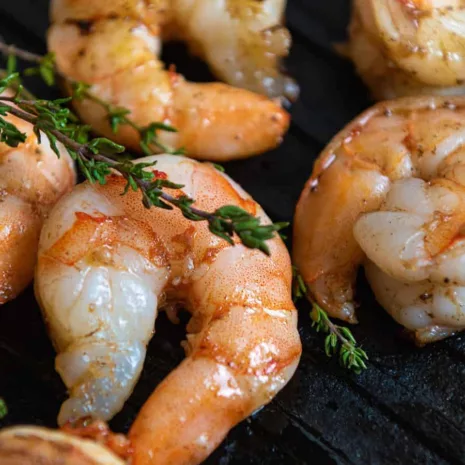
The sauce that clings is steamed salted egg yolk mashed fine, melted into butter over a low fire until it foams, with curry leaves and cut chilli in the pan. The prawns are fried shell-on with a light cornflour dust. That rough, crisp shell is the grip: salted egg foam holds onto it the way it never holds onto a smooth peeled prawn.
The usual problem. The sauce turns out gritty, or it splits into oily butter with yolk sand at the bottom of the wok, and most of it stays on the plate instead of on the prawn. All three failures come from heat and mash, not from the shopping list.
Why shell-on frozen prawns hold the sauce better
A fried prawn shell is not smooth. Cornflour and hot oil blister it into a dry, rough crust, and foamed salted egg butter grips that crust and sets on it as it cools. Peel the prawn first and you are asking the sauce to hang onto wet glass. It slides, it pools, and the last bite is sauce off a spoon instead of sauce off a prawn.
The shell earns its place twice more. In the wok it stands between the flesh and the frying oil, so the prawn inside stays juicy while the outside crisps. In the freezer it stands between the flesh and the cold air, which is why shell-on is how good frozen prawns are usually packed. Buy them shell-on, keep them shell-on, and let your guests peel at the table with sauce on their fingers. That is half the dish.
Which prawns to buy for this
Size matters more than species. Mid-size prawns fry through in the same two minutes it takes the shell to crisp, so shell and flesh finish together. Jumbo prawns look grand on the plate but need longer in the oil, and the shell can overshoot while the middle catches up. Vannamei and tiger prawns both work; tigers bring a firmer bite and a showier stripe. On sizing, read the count printed on the bag: the smaller the number, the bigger the prawn.
Prep the prawns
- Thaw sealed in ice water, bag leak-proof and the water changed as it warms,1 or in the chiller overnight. Never loose in the sink.2
- Trim the legs and feelers with scissors. Keep the shell and tail on.
- Devein through a shallow snip along the back of the shell. The same cut lets a little sauce reach the flesh.
- Dry them hard with paper towels, then dust lightly with cornflour. A wet prawn spits in the oil and never crisps, and the crust is the whole point.
The yolk paste
Buy salted duck eggs and take the yolks: four for 500g of prawns. Steam them for ten minutes until firm, then mash them through the back of a fork until they are fine crumbs, almost powder. This is the step that decides smooth or gritty. Every lump you leave now is grit in the sauce later, and no amount of stirring in hot butter breaks a lump the fork did not. Short on time, salted egg powder from the baking aisle works, about three tablespoons, but yolks you steamed and mashed yourself foam better and taste less sweet.
Fry, then sauce
- Fry the prawns in hot oil, about two minutes, until the shells crisp and turn coral. Lift them onto a rack, not paper, so the crust stays dry.
- Pour off the oil. Melt 60g of butter on a low fire with two stalks of curry leaves and two cut chilli padi. Low is the rule of the whole dish: golden butter is flavour, browned yolk is bitter.
- Add the yolk crumbs and stir. In about a minute the butter and yolk foam up together like the head on a beer. That foam is the cling forming. If nothing foams, the fire is too low; if it browns, too high.
- Season with a pinch of sugar and a pinch of salt.
- Prawns back in. Toss for thirty seconds until every shell wears a coat of foam, then plate before the foam settles.
Where it goes wrong
- Heat too high. The butter splits and the yolk toasts bitter. The foam stage only happens on low.
- Yolks under-mashed. Grit, no matter how well you cook the rest.
- Prawns not dried. No crust forms, and the sauce slides off a steam-soft shell.
- Milk in the pan. Some zi char stalls pour in evaporated milk for the creamy, gravy-style version. It tastes good, but understand the trade: it is a gravy now. Gravy pools. Foam clings.
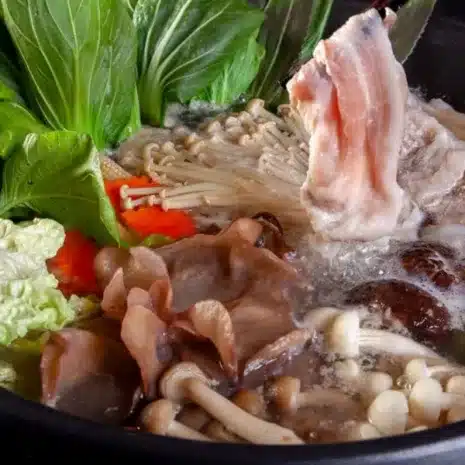
Get those four right and the plate arrives the way the zi char version does: shells crackling, sauce set onto every prawn, and nothing left at the bottom but curry leaves worth fighting over. The same prawns work in a steamboat, where tiger and vannamei part ways.
Shell-on prawns, sauce that stays
The crisp shell is half the recipe. Start with prawns frozen shell-on for the grip.
- Singapore Food Agency, Guidelines on Thawing of Food (updated 27 Sep 2024): “Frozen food should therefore not be left to thaw at room temperature, to prevent food poisoning bacteria that may be present from multiplying to high levels.” The same introduction names the fast method: “Frozen food can also be thawed by submerging in ice water, with frequent change of water and it must be sealed in a clean leak-proof package or container.” sfa.gov.sg (PDF, p.1) ↩︎
- SFA, same guidelines, “Thawing by Submerging in Ice Water”: “Place food to be thawed in a clean leak-proof packaging. Submerge the package in a container of clean ice water with frequent change of water to ensure that the temperature of the ice water is kept at not above 4°C, as the food continues to thaw. Do not place food directly in the sink or into container of water without packaging it.” sfa.gov.sg (PDF, p.3) ↩︎