
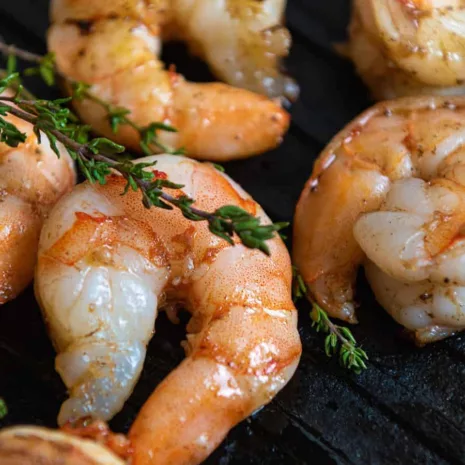

The fast way to thaw prawns is a sealed, leak-proof bag submerged in ice water, with the water changed often so it stays cold.1 It beats the chiller by hours and it protects the texture, because the prawns never sit warm. The chiller overnight is still the best default when you can plan ahead. Everything else, the counter, the hot tap, is how prawns end up rubbery.
The usual problem. Dinner is in an hour and the prawns are a solid brick. The hot-water trick gets them apart fast, and then the pan turns them into erasers. The shortcut is not the problem. The wrong shortcut is.
Why prawns turn rubbery
Prawns are small and they cook in minutes, so their texture has almost no margin. Thaw them in warm water and the thin outer flesh sits warm the whole time the core is still frozen. By the time the middle lets go, the outside has already started tightening, and the pan finishes the job. That is the bounce you get in a bad prawn: it was half cooked before it ever hit the heat.
Cold thawing keeps every part of the prawn below the point where any of that starts. The goal is simple: thawed in the middle, cold everywhere. Scallops behave differently, and there is a method for searing scallops straight from frozen.
What the warm water is doing to the prawn
Prawn flesh is mostly water held in a fine mesh of protein. Heat sets that mesh, and as it sets it tightens and squeezes the water back out. That is the difference between a prawn that yields and one that bounces off your teeth.
The setting starts well below a simmer, at a temperature your hand still calls warm. So a warm thaw is already cooking, slowly and badly. The outer few millimetres give up water while the core is still solid, and no frying puts it back. Cold water never reaches that range, so all of the cooking happens in the pan.
The ice-water method, step by step
This is the method SFA describes for thawing food fast, and it maps perfectly onto prawns.2
- Keep the prawns sealed. Leave them in their unopened bag, or move them into a zip bag and press the air out. Never put them straight into the water.
- Submerge the bag in a container of ice water. A few cubes in cold tap water is enough to hold it.
- Change the water as it warms so it stays cold the whole way through.
- Feel through the bag for ice crystals. If you find any, keep going until there are none.3
- Cook straight away. Ice-water thawing is a now-cooking method, not a hold-for-later one.
Loose individually frozen prawns come apart and finish fastest. A solid block takes longer, so break it up gently through the bag as soon as it starts to give. Bigger prawns take longer too, which is what the prawn size numbers mean in practice.
Why ice water beats a running tap
Water moves heat far faster than air, so any water bath beats a packet in the chiller. But the baths are not equal. A cold tap in Singapore is not cold: it runs near room temperature most of the year, warm enough to start setting the outside of the prawn.
Ice water holds at zero. Melting ice soaks up heat without the water around it getting warmer, so the bath stays at the same temperature until the last cube goes. Swirl the bag every few minutes too: still water turns lukewarm right against the plastic, and that layer slows the thaw.
How to tell they are thawed all the way through
Pinch a prawn through the bag. A thawed one gives and springs back. A frozen core is a hard line down the middle that will not compress.
Judge the thickest part, the head end of the body: it is the last to let go. Cold and firm is right, hard is not, and crystals under the shell mean not yet. If unsure, five more minutes in fresh ice water. A frozen core in a hot wok costs you the dish.
The chiller method, when you can plan ahead
Move the prawns from freezer to chiller the night before, on the lowest shelf and on a tray or in a container so nothing drips onto other food. The chiller keeps them in the safe range from start to finish, and the texture comes out exactly as the packer froze it. Thaw only what you plan to cook.4
If dinner plans die, chiller-thawed prawns will hold until the next day. Ice-water prawns will not: cook them the day you thaw them. Salted egg prawns are one good way to use them.
Dry them before they go near the pan
Thawed prawns shed liquid into the bag. Some of it escaped when ice crystals broke the cell walls in the freezer, one of the real differences between frozen and fresh. Pour it away, not into the pan.
Then dry them. Spread them on kitchen paper, blot the tops, and give them a minute in the air. Surface water has to boil off before anything can brown, so a wet prawn steams in its own puddle while the pan loses heat. A dry prawn colours in under a minute. Salt after drying, not before.
Can you cook prawns straight from frozen
Into liquid, yes. Prawns bound for soup, curry, laksa or a steamboat pot can go in frozen. The liquid thaws and cooks them in one step, and there is no surface to brown. Judge by colour: pink and opaque through, no grey at the thickest point.
Into a pan, no. A frozen prawn drops ice into hot oil, the temperature falls, and you steam the batch instead of searing it.
What never to do
The counter. Room-temperature thawing is the one SFA warns about directly, because the surface spends hours in the range where bacteria multiply fastest. With prawns it is also the slowest route to the worst texture.
Hot or warm water. It is the rubbery-prawn machine from the section above, just faster. The official method is ice water for a reason: cold is the whole point, not a side effect.
Refreezing. Once thawed, prawns are on a one-way trip to the pan. If you thawed too many, cook them all and chill the extras cooked.5
Start with prawns worth thawing
Good frozen prawns thaw into good prawns. The method only protects what the freezer was given.
- Singapore Food Agency, Guidelines on Thawing of Food (updated 27 Sep 2024): “Frozen food should therefore not be left to thaw at room temperature, to prevent food poisoning bacteria that may be present from multiplying to high levels.” The same introduction names the fast method: “Frozen food can also be thawed by submerging in ice water, with frequent change of water and it must be sealed in a clean leak-proof package or container.” sfa.gov.sg (PDF, p.1) ↩︎
- SFA, same guidelines, “Thawing by Submerging in Ice Water”: “Place food to be thawed in a clean leak-proof packaging. Submerge the package in a container of clean ice water with frequent change of water to ensure that the temperature of the ice water is kept at not above 4°C, as the food continues to thaw. Do not place food directly in the sink or into container of water without packaging it.” sfa.gov.sg (PDF, p.3) ↩︎
- SFA, same guidelines: “Check for ice crystals in the food using your hand or a skewer. If food is not fully thawed, continue to thaw the food until no ice crystals are present. Test again before cooking or reheating.” sfa.gov.sg (PDF, p.1) ↩︎
- SFA, same guidelines, on chiller thawing: plan for a refrigerator or chiller “maintained at a temperature not below 0°C and not above 4°C”, thaw raw food on the lowest shelf on a tray to prevent drippings reaching other food, and “Thaw only the amount of food you require for cooking.” sfa.gov.sg (PDF, p.2) ↩︎
- SFA, same guidelines: “Cook thawed meat immediately and do not refreeze thawed food. Improper handling and refreezing of food may lead to the growth of bacteria.” sfa.gov.sg (PDF, p.1) The prawns this method suits, shell-on or peeled: our seafood selection. ↩︎